


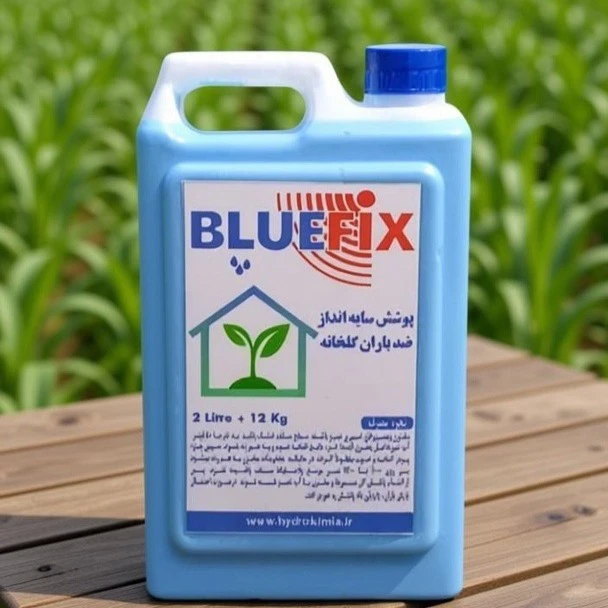
With the arrival of spring and rising temperatures, maintaining optimal conditions inside the greenhouse—particularly regarding light and temperature—is essential to prevent a decline in both the quality and yield of the harvest.
Providing shade and reducing the amount of incoming light can be highly effective in regulating the internal temperature of the greenhouse and lowering cooling costs.
Shading a greenhouse does not need to be complex or expensive; the primary objective is simply to lower the internal temperature.
Currently, in the year 1400 [approx. 2021/2022], the cost of plastic shade netting is approximately 10,000 to 12,000 Tomans per square meter. In contrast, the cost for a waterproof, rain-resistant powder coating or paint is 40 to 50 times lower.
Furthermore, when plastic shade netting is used, sunlight passes through the mesh openings, while other areas remain completely blocked. This means that while the netting reduces the overall intensity of light, it fails to distribute it uniformly throughout the greenhouse. Consequently, many parts of the plants receive no light at all.
In contrast, a waterproof, rain-resistant powder coating or paint creates a continuous film over the greenhouse roof. This ensures uniform light distribution throughout the entire space, allowing all plants to receive an equal share of light. As a result, photosynthesis occurs consistently across all leaves. Even the lower leaves—those near the ground—receive some light due to reflection, ultimately leading to a relatively uniform light environment throughout the entire greenhouse. A low-cost method for reducing solar radiation involves using a shading compound—such as a powder or a water-resistant coating—that is sprayed onto the exterior or the roof of the greenhouse. These shading compounds help reflect solar radiation before it enters the greenhouse, thereby preventing some heat from getting in.

No comments yet.