


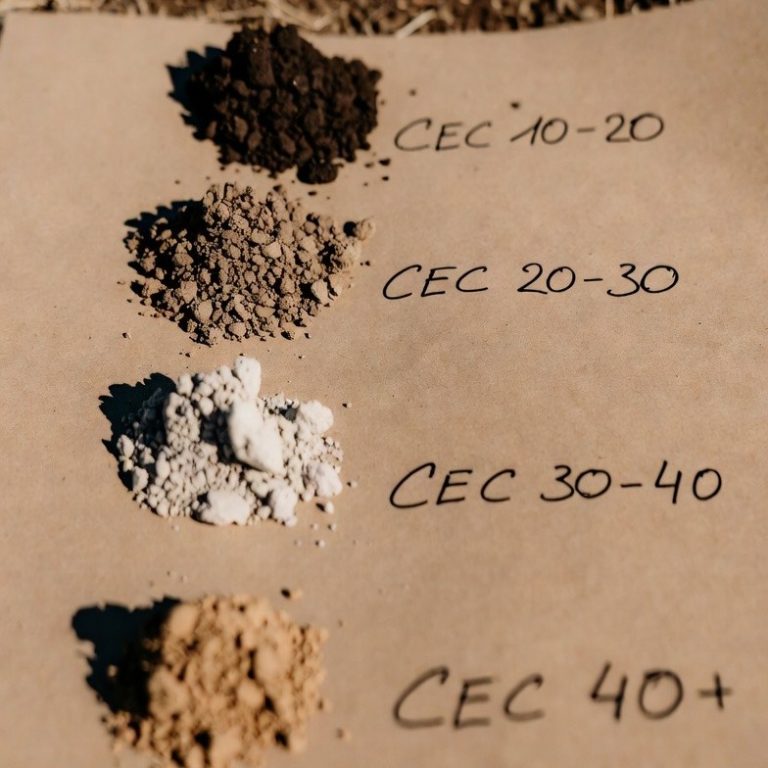
Soil Cation Exchange Capacity (CEC) is a measure of the soil’s ability to retain positively charged ions. It is a critical soil property that influences physical soil stability, nutrient availability, soil pH, and the soil’s response to fertilizers and amendments.
The surfaces of clay particles or organic colloidal particles carry negative charges (-), which results in the attraction of positively charged ions, or cations. When water is added to the soil, these cations can move into the soil solution; however, because they remain attracted to the surfaces of clay or colloidal particles, they tend to cluster around them.
The mechanism by which cations are adsorbed onto and desorbed from these negatively charged sites is significant. Nevertheless, at any given time, less than 1 percent of the total cations are actively undergoing this process—largely because those that detach are taken up by plants. Conversely, when cations are adsorbed onto soil particles, they become stabilized, which reduces the leaching of these nutrient cations.
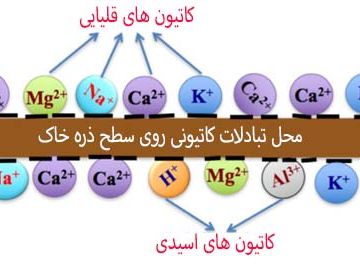
Positively charged ions can be easily and repeatedly replaced or displaced on negatively charged soil particles by other cations present in the soil solution—a process known as cation exchange. The most important exchangeable cations are:

For a cation to be absorbable by a plant, it must first move from the surface of a clay particle into the soil solution, where it is then replaced by another cation present in the soil solution. Plant roots facilitate this process by releasing hydrogen ions (H+) into the soil solution, which are then exchanged for a nutrient cation (such as potassium, K+). The cumulative effect of the hydrogen ions released by the plant leads to an increase in soil acidity (provided that a cation like potassium is not replaced). (In this way, the addition of hydrogen ions contributes to the weathering of primary minerals—such as feldspar—and secondary minerals—such as kaolinite—found in the clay.)
This replacement process is known as “cation exchange.” It occurs when a cation moves from the soil solution into the sphere of influence of a cation already occupying a site on the surface of a negatively charged particle. This mechanism is illustrated schematically in the adjacent figure, showing a potassium cation being displaced from the surface of a clay particle by a hydrogen ion.
You may also watch the video below:
https://www.youtube.com/watch?v=IHHE3rHGrqo
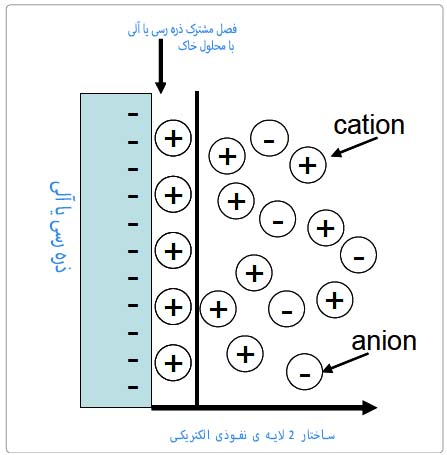
Cation exchange is defined as the exchange of cations between the surface of negatively charged particles (such as mineral clays or organic colloids) and the soil solution. Although the cations remain associated with the clay particles, the attractive force exerted upon them decreases sharply as the distance from the negatively charged particle surfaces increases.
This phenomenon—the adsorption of cations onto the surfaces of negatively charged particles—is known as the “diffuse double layer.” It is termed a “double layer” because it consists of two layers of opposite charge (negative and positive), and “diffuse” because the outer layer—composed of cations—is not sharply defined. The attractive force between the negatively charged particles and the cations diminishes rapidly with increasing distance.
Beyond their role in plant nutrition, cations also influence the physical properties of soil clays. This is because the binding strength of individual cations depends on several factors, including:
The charge of the cation (i.e., its valence);
The size of the hydrated cation (i.e., its ionic radius);
And the charge density and the thickness of the double layer extending from the surface of the clay particles.
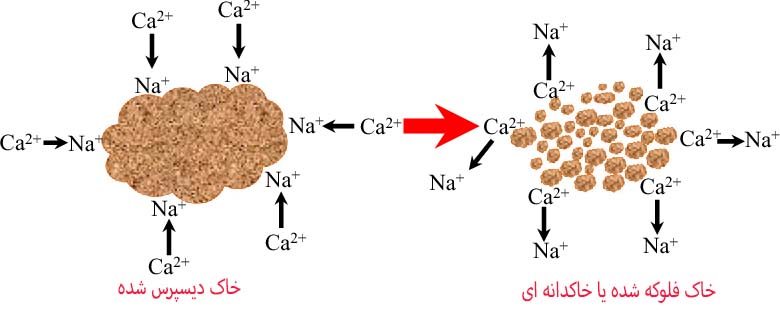
Regarding the first factor, the more firmly a cation is bound to an exchange surface, the greater its affinity for adsorption. This is referred to as “adsorption energy.” The adsorption energy of a cation is a function of its valence (i.e., its charge). Consequently, trivalent cations (such as aluminum) and divalent cations (such as calcium and magnesium) possess an adsorption energy approximately two to three times greater than that of monovalent cations (such as potassium and sodium). Consequently, an exchangeable cation—such as aluminum, calcium, or magnesium—remains in the vicinity of the clay particle; it does not interfere with the cohesive forces between the particles, but rather promotes the aggregation (clumping) of the soil.
The valence of an exchangeable cation determines the thickness of the diffuse double layer; consequently, a higher valence results in a thinner double layer. Nevertheless, variations in double-layer thickness can still occur even when cations possess the same charge and valence.
When cations have the same valence (for instance, both are +1), the cation with the smaller hydration radius exhibits stronger adsorption. In the case of the monovalent cations sodium and potassium, the potassium ion has a smaller hydration radius and is, therefore, more strongly adsorbed onto negatively charged sites.
In contrast, sodium—often associated with soil salinity—is relatively loosely held and highly mobile; as a result, soils containing sodium disperse easily, leading to the loss of soil aeration pores.
Relative soil aggregation capacity | Hydration radius | Charge capacity per molecule | Cation |
|---|---|---|---|
| 1 | 0.79 | 1 | Na |
| 1.7 | 0.53 | 1 | K |
| 27.0 | 1.08 | 2 | Mg |
| 43.0 | 0.96 | 2 | Ca |
This is quite similar to the behavior of divalent cations such as calcium and magnesium. Since a hydrated magnesium ion is larger than a hydrated calcium ion, it is less constrained and experiences weaker surface adsorption forces. Consequently, much like sodium, it moves freely through the soil, which can sometimes lead to soil dispersion.
In summary: A larger hydration radius means the cation is positioned further away from the negatively charged site; as this distance increases, the surface adsorption force decreases. This greater freedom of movement facilitates dispersion and the breakdown of soil aggregates.
The charge of a cation and the size of its hydrated form govern the dynamics of cation exchange equilibrium. Briefly, highly charged cations tend to bind more strongly than those with lower charges. Furthermore, cations with a smaller hydration radius form stronger bonds, making them less likely to be displaced from the exchange complex.

The combined effect of these two criteria is referred to as the “lyotropic series.”
The figure above illustrates the decreasing adsorption strength of various cations, moving from left to right. Consequently, cations positioned toward the far right—those located further from the colloid surface—are more susceptible to leaching. Conversely, cations on the left (which are more strongly adsorbed to colloidal surfaces) move more slowly through the soil profile and are less prone to leaching.
The type and proportion of cations adsorbed onto mineral particles and organic colloids are also a function of the cation concentration within the soil. A higher concentration of a specific cation increases the likelihood of that cation being adsorbed onto negatively charged particles.
This principle explains the use of calcium sulfate in the reclamation of saline-sodic soils. In this process, calcium sulfate (gypsum) dissolves in the soil, increasing the concentration of calcium ions. These calcium ions are then adsorbed onto negatively charged surfaces—effectively increasing the cation exchange capacity—and displace sodium ions. The displaced sodium is subsequently leached from the soil during the next irrigation event.
The primary sources of cations in the soil solution are the weathering of minerals and the application of soil amendments, such as lime and gypsum.
http://www.terragis.bees.unsw.edu.au/terraGIS_soil/sp_exchangeable_cations.html

No comments yet.