


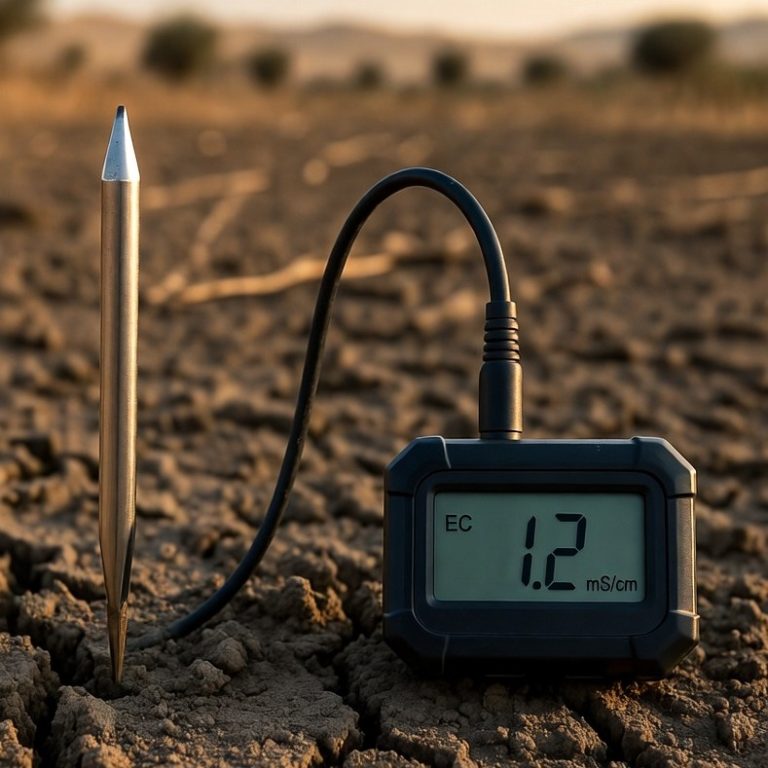
What is the relationship between soil salinity and soil electrical conductivity? How are soil salinity levels and electrical conductivity related, and how are soils classified based on these parameters? How does the electrical conductivity of a soil extract vary in sodic and saline soils?
Fundamentally, soil salinity is a measure of the concentration of all water-soluble salts present in the soil. Often, ion activity—rather than simple concentration—is used to express salinity levels; however, this requires measuring the concentration of every individual ion present in the soil extract, a process that is both difficult and time-consuming. Consequently, soil salinity is typically expressed in terms of Electrical Conductivity (EC). While there are two methods for measuring electrical conductivity, the results obtained from them are interrelated. The first method involves measuring the electrical conductivity of a soil extract or soil paste, while the second method involves measuring the electrical conductivity of a soil-water mixture prepared at a 1:5 weight-to-volume (w/v) ratio (EC 1:5 w/v).

At the same time, given that the adverse effects of salinity depend on the plant species, its growth stage, environmental factors, and the nature of the soil, it is very difficult to provide a precise definition of soil salinity.
Excessive salinity—particularly in the root zone—slows down and disrupts the plant’s uptake of water and nutrients. The predominant mineral salts are:
Cations | Anions |
|---|---|
| Sodium+Na | Chloride-Cl |
| Potassium+K | Sulfate2-SO4 |
| Magnesium2+Mg | Bicarbonate-HCO3 |
| Calcium2+Ca | Nitrate-NO3 |
| Hydrogen+H | Carbonate2-CO3 |

In terms of the definition of soil salinity, soil is considered “saline” when the electrical conductivity (EC) of the extract obtained from a saturated soil paste reaches or exceeds 4 deciSiemens per meter (4 dS/m) at a temperature of 25°C. This definition is found in the latest American soil science reference materials.
According to the reference *USSL Staff (1954) Diagnosis and Improvement of Saline and Alkali Soils* (USDA Handbook No. 60, Washington D.C., USA, 160 pp.), the relationship between salinity levels and plant growth is categorized as follows:
– Non-saline (ECe ≤ 2 dS/m): Salinity effects are negligible.
– Very slightly saline (ECe 2–4 dS/m): The yield of sensitive plants may be restricted.
– Slightly saline (ECe 4–8 dS/m): The yield of many plants is restricted.
– Moderately saline (ECe 8–16 dS/m): Only salt-tolerant plants produce acceptable yields.
– Highly saline (ECe > 16 dS/m): Only highly salt-tolerant species are able to produce a yield.
| Salinity Stratification | EC1:5 Sandy(mS/m) | EC1:5 Sandy clay(mS/m) | EC1:5 Clayey (mS/m) | ECe Extract (mS/m) |
|---|---|---|---|---|
| Non-salty | 0–14 | 0–18 | 0–25 | 0–200 |
| Low salinity | 15–28 | 19–36 | 26–50 | 200–400 |
| Moderate salinity | 29–57 | 37–72 | 51–100 | 400–800 |
| High salinity | 58–114 | 73–145 | 101–200 | 800–1600 |
| Severe salinity | 115–228 | 146–290 | 201–400 | 1600–3200 |
| Very intense saltiness | >228 | >290 | >400 | >3200 |
