


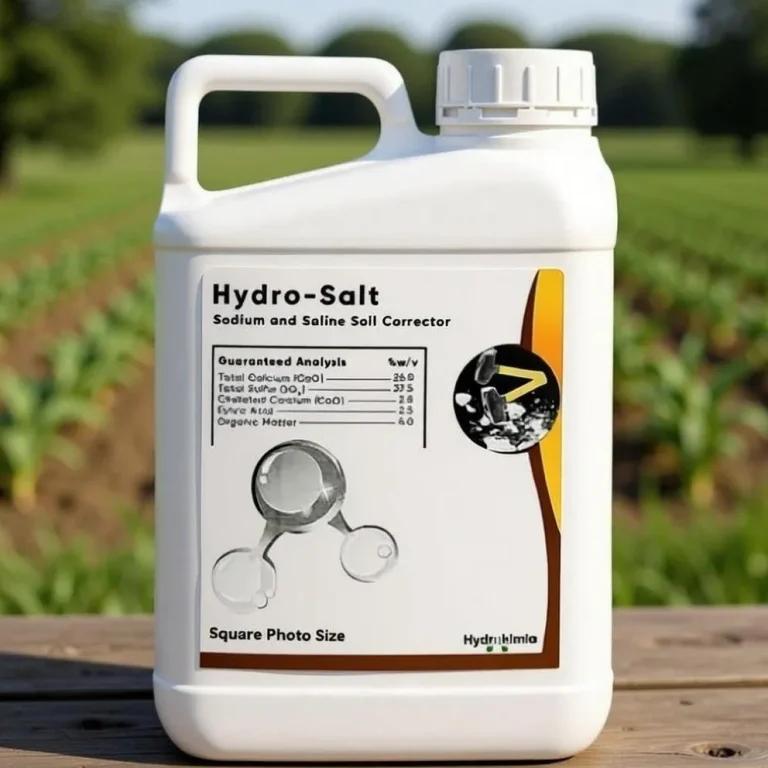
The two main problems of saline soils that Hydrokimia’s anti-salinity fertilizer corrects:
Separating Sodium Ions First, it separates the ions that are bound to organic matter and soil clay.
Calcium (CaO) ← Amending agent
Sulfur (SO₃) ← Soil property improver
Fulvic acid ← Increases the soil’s cation exchange capacity (CEC) by up to 1,400 times that of ordinary humic substances.
› Cultivation of field and horticultural crops (wheat, barley, cotton, sugar beet, grapes, pistachios, etc.)
› Greenhouse crop cultivation (vegetables, shrubs, etc.)
› Arid and semi-arid regions (where this fertilizer is essential due to water scarcity)
› Open-field soils
›Unique composition
›Reduction of exchangeable sodium
›Increased soil permeability and moisture retention
›Improvement of physical structure
›Reduction of soil pH
›Provision of essential sulfur for the soil
› Reducing the impact of salt on plants (Anti-salinity fertilizers can mitigate the effect of salt on plants by increasing the availability of nutrients and facilitating their uptake.)
› Reducing the use of chemical fertilizers
› Preserving soil structure
› Improving agricultural crop production
› Enhancing nutrient uptake by the roots
What happens if we do not use anti-salinity fertilizer?
Degraded soil structure (it may no longer be suitable for cultivation).
Soil salinity accumulates around the roots, affecting the plant and causing its green parts to dry out.
The soil requires frequent and substantial amounts of water.

No comments yet.